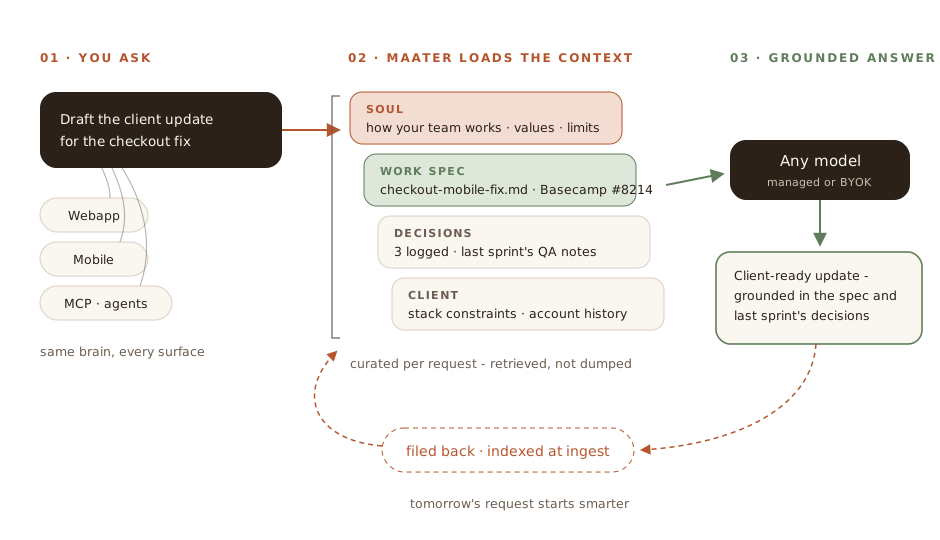
Agents inherit how your team works
Identity, values, and limits travel with the workspace - so every session starts with context, not a blank slate.
Your knowledge. Your way.
One workspace where your team's knowledge and its AI live together - work specs, meetings, decisions, client history.
AI finally has somewhere real to stand - so no one, and no agent, starts from zero.
Say it like matter. Built in daily use inside a working dev agency.
The problem
You added AI. You got more silos.
Every tool sprouts its own assistant. None can see across the others, so you patch the knowledge together by hand.
Every session starts cold. You re-explain the client, the plan, the history - to teammates, to stakeholders, to every tool.
Buried in email, comments, transcripts, and threads. More time excavating than building.
The fix isn't another AI tool. It's one place your team - and its AI - can finally see.
Not smarter chat. Firmer ground.
See it work
A trigger becomes a living work doc - what you already know, what context matters, who executes, and how it closed. Same artifact end to end. Shared work, not shared chat.
01 Trigger
Work starts somewhere - a Basecamp todo, comment, or meeting today; any API-backed system via a flow trigger next. Capture what you already know, then shape adjacent context onto the same doc. One inbound request, one document to carry it.
Request · via flow trigger
Fix broken checkout on mobile - Basecamp #8214 (or any API)
+ Capture
Comment thread, the ask, constraints - filed before anyone invents a plan
+ Shape
Prior specs, decisions, client notes on the same doc
starts a work spec ↓
Work spec - ready to dispatch
Stakeholder timeline, technical read, client-ready update
04 Execute
Delegate as needed. Any coding agent pulls the spec and the connected knowledge over MCP. The Cursor / VS Code extension is optional: docs on disk, two-way sync. Hit a client approval, come back weeks later - nothing's lost.
05 Complete
Mark done and write execution notes on that same document. Status, decisions, and outcome stay findable. The next similar request starts loaded - captured and searchable from the moment it arrives.
Work spec · done
status: done · review: passed · PR #214 merged
History captured
3 decisions logged, sprint QA notes, client stack constraints
reused later ↓
A new task finds it
"Similar checkout bug" - the agent surfaces this spec first
A real moment
A developer opened a new AI chat on a large Speedy rebuild. The agent recommended a cache-clear strategy already proven on a smaller Speedy site the team had shipped - because the work spec and meeting notes linked that prior case. He thought the model remembered his last project. It did not. The shared knowledge did.
The model is a commodity. The shared knowledge is yours.
Nothing you make lands outside the graph. Google Docs flow in and push back out. Zoom calls file themselves - transcript, summary, and action items attaching right to the work spec.
Living system
Every result loads the next one. Soul - identity, values, and voice - cascades from you, your team, and each project. The knowledge graph is indexed by meaning the moment each document lands, so anything the org knows is one search away.
Identity, values, and limits travel with the workspace - so every session starts with context, not a blank slate.
Not just notes. Work has shape - origin, status, and enough structure for a colleague or an agent to pick up cold.
Compose a view over the work you already have - without building another spreadsheet that goes stale.
Steps run against your documents, soul, and agents - not a generic pipe between tools that do not know you.
Surfaces
Surfaces are where you reach your knowledge - the same graph, wherever you work. Read and edit on the web, capture on your phone, or let your coding agent work with it in place over MCP. Open it anywhere - it's the same brain underneath.
Point any MCP client - Cursor, Claude Desktop, Claude Code - at Maater, and your whole knowledge graph is one toggle away.
Extensions
Knowledge with gravity. Tools that orbit it. Surfaces are how you reach in; extensions are what Maater reaches out to - the tools where work already happens, plus your own systems over an API.
Your AI
Sovereignty is how the product is built - not a premium checkbox. Pick what fits today; grow into more control when you need it. Read the full sovereignty stance.
Pick a model in chat with nothing to configure - or plug in your own Anthropic, OpenAI, or similar account. Your compute, your bill, your rate limits.
Point Maater at your own inference - self-hosted or private cloud - or run the whole stack on your own hardware. Active track; we say path, not shipped.
How it's different
The comparison that matters isn't feature count - it's what's true by default. Models are interchangeable. Your knowledge is not.
| Notion | Obsidian | Mem.ai | Maater | |
|---|---|---|---|---|
| AI indexed at ingest | Enterprise only | Plugin-dependent | Individual | Always |
| Built for teams | Yes | No | Limited | Yes |
| Work has a traceable origin | No | No | No | By default |
| BYOK / choose your AI | No | N/A local | No | Yes + path |
| Self-hostable | No | Files only | No | Path |
| Basecamp-native | No | No | No | Yes |
| Agent access (MCP for IDEs) | No | Community | No | Yes |
Early access
A small group of teams - agencies and dev teams doing client work - is shaping Maater now. Bring your real work; help decide what ships.
On the name: say it like matter. Maat is order and truth, matter is what counts, mater is the source.
No pricing yet. No spam. Just a seat while the product hardens. We reply personally - usually within a couple of days.